
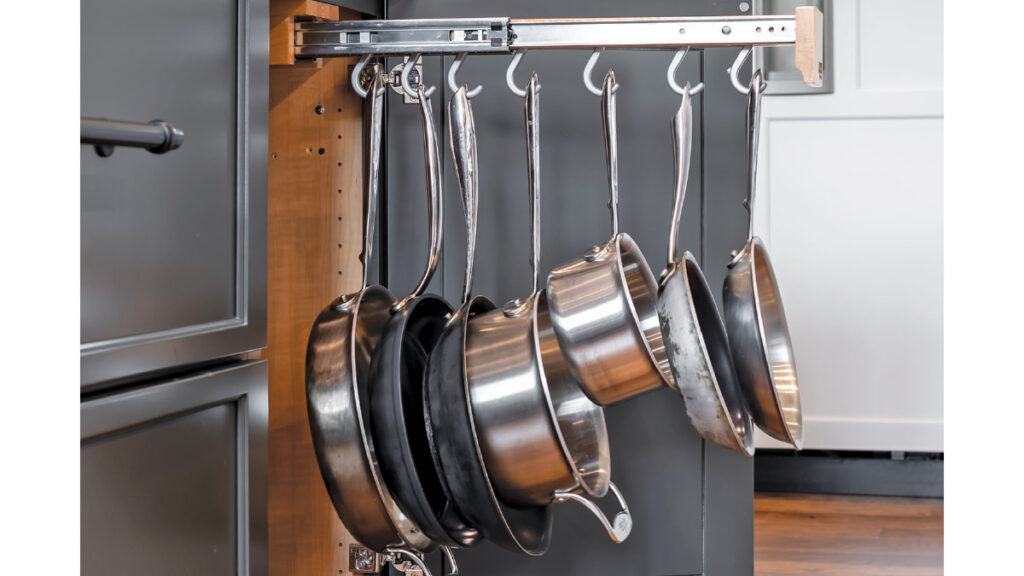
Cabinets with pots and pans stacked precariously, shoes and clothes crammed into closets—these are not uncommon sights in any home. Clutter can creep into all corners of a house, but the kitchen and closets are perhaps the most susceptible. We reached out to local experts for solutions to clear clutter and get organized.
CLOSET
know your space
Limited closet space is a problem that many homeowners deal with. Savannah Wandzel, sales and design administrative coordinator and design consultant for California Closets, suggests having realistic expectations about what can fit. “Figure out your priorities, so you can maximize the space,” she explains. “Some things may have to be stored in separate areas, so consider possible alternatives. You may also want to declutter before you organize. Are you holding onto items that you don’t wear anymore? Get rid of them.”
hanging around
“The No. 1 issue I see in homes is a lack of hanging space,” Wandzel notes. “It’s something we want to prioritize when creating an organizational system.” Another element many closets lack is shelves—usually there is only one near the ceiling. This can make storing shoes and bags tricky. Wandzel suggests also adding drawer space.
stylish storage
Closet reorganization is practical, but it also can be aesthetic. One trend Wandzel is seeing more of is adding glass elements, such as Shaker doors to organizational systems. “Bright white also is very popular—although that has always been the case,” she notes. “People also are looking for ways to organize their jewelry in functional but also fun ways.” Tie and belt storage as well as built-in hampers are also popular elements to add to closets. To take the space to the next level, Wandzel suggests incorporating lighting into the design.
trust the process
Wandzel begins a closet remodel by visiting the home and taking inventory of what needs to fit in the space. “I take dimensions and ask questions to learn the homeowners’ wants and needs,” she explains. “After I put together the design, I present it to the homeowner. This is the fun part—they get to see a rendering and make edits so it’s perfect for them.” Installation is typically done all at once, and Wandzel likes to follow up with clients in the following weeks to ensure they are happy with the final product.
KITCHEN
know your routine
When starting to organize, Andrea Liston, director of design for Liston Design Build recommends thinking about what you use the most, especially if you have limited space. “If you make coffee every day but only bake a cake once every few months, you’re going to give your coffee maker priority over your stand mixer,” she says. “Day-to-day functionality is important. If you remodel your kitchen, you’ll be kicking yourself if you don’t consider where the air fryer or tupperware is going beforehand.”
cabinet woes
Liston notes that homeowners often have issues with prefabricated cabinets. “Most include a piece of wood between the two doors, which can make storing dishes and other things more difficult because the opening is smaller,” she explains. “In remodels, we usually take that out for ease of access.” Another common issue with cabinets is that the lower ones can be difficult to access without bending over or kneeling. Liston suggests replacing them with drawers so you can easily see what’s inside without having to get on the floor.


declutter
“Our kitchen counters are often overloaded with appliances, cookbooks, spices, groceries, kids’ stuff and more,” Liston says. “We’re seeing that one of the keys to a good remodel is ensuring that there is a place for everything. It not only uses the space efficiently, but it helps hide that clutter that every working kitchen has.” Specialized organization includes spice storage, special cabinets to store baking sheets, stand mixer lifts, dedicated utensil drawers, appliance garages and pull-out trashcans to ensure walkways remain unobscured.
contain it
If a full-scale kitchen remodel isn’t an option, Liston suggests beginning with taking inventory. Then start implementing organization aids like containers and drawer dividers. “Take a piece of craft paper and use it to measure your drawers,” she recommends. “Then you can take it with you to the store and use it to see what will fit in the space you have. That way you don’t have to do the buy-it-and-try-it method. A few containers is a great place to start.”