
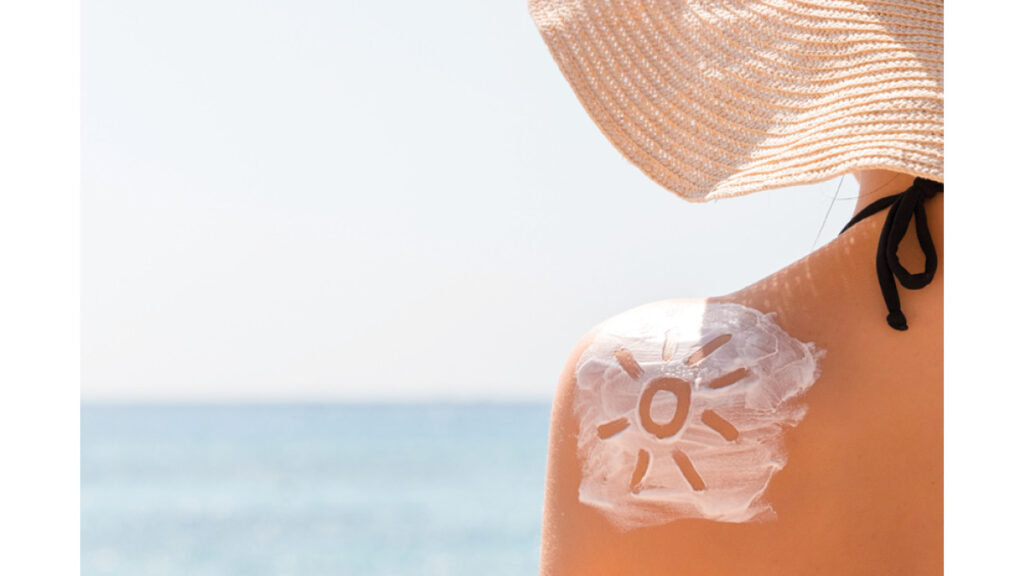
The weather is warming up each day, which means everyone is eager to get outside and enjoy it. But while sunshine boosts mood and allows for lots of fun outdoors, it contains harmful ultraviolet (UV) rays. Exposure can prematurely age the skin (yikes!) and even lead to skin cancer (double yikes!). For Skin Cancer Awareness Month, we’re sharing how you can make protecting your skin a priority—while still enjoying fun in the sun.
How does sunscreen work?
There are two main ways sunscreen protects you from UV light. Chemical sunscreen acts like a sponge. It absorbs the sun’s rays, using one or more of these active ingredients: oxybenzone, avobenzone, octisalate, octocrylene, homosalate and octinoxate. These products tend to be easier to rub into the skin and don’t leave behind as much residue. Physical sunscreen acts like a shield, deflecting sunlight off of you. These products contain zinc oxide, titanium dioxide or a combination of both. Since these products sit on the surface of the skin, they leave more residue. The American Academy of Dermatology (AAD) recommends physical sunscreens for people with sensitive skin.
What SPF do you need?
SPF stands for sun protection factor, and it measures how well your sunscreen stands up to UVB rays, which are responsible for burning the top layers of the dermis. UVA light penetrates deeper, but protection against it isn’t rated. If a product is labeled ‘broad spectrum,’ it has demonstrated it protects against both UVA and UVB exposure. Both types of UV light can cause skin cancer, so it’s important to choose a sunscreen that offers coverage against both.
The SPF number is calculated by how long it takes treated skin to burn when compared to skin with no sunscreen applied. So if you use a product rated SPF 15, it will take 15 times more sun exposure to burn than if you weren’t wearing it. However, tests to determine SPF are conducted in laboratories under ideal circumstances. In practice, you’re likely not as protected as the number on the bottle indicates because your sunscreen is going to wear off due to exposure to the elements.
The U.S. Food and Drug Administration (FDA) suggests using products with an SPF of at least 15, and the AAD recommends using nothing less than SPF 30.
How much sunscreen should you use?
According to the AAD, most people only apply 25% to 50% of the recommended amount of sunscreen. You should use enough to cover any skin that isn’t clothed. For adults, that generally means 1 ounce, which is enough to fill a shot glass.
Is there waterproof sunscreen?
No product is completely waterproof; they all will eventually wash off. If a sunscreen is labeled ‘water resistant,’ that means it remains effective for 40 minutes when swimming or sweating, and if it’s ‘very water resistant,’ it works for 80 minutes in water. The bottle should include instructions on when to reapply.
Does it matter if I use a cream, gel or spray?
That is up to personal preference. The AAD cautions that spray sunscreens can make it difficult to ensure enough product is applied to be effective. It is recommended to apply the product until the skin glistens and then rub it in to get even coverage. Also, make sure you never spray around your face or mouth to avoid inhalation.
Does sunscreen get absorbed into your body?
Research from the FDA has shown that the active ingredients in sunscreen can be absorbed into the bloodstream through the skin. This can happen even after only a single application. The findings do not necessarily mean that the ingredients are unsafe, but additional data is necessary to fully determine whether there are long-term effects of absorption.
sun protection tips
- Avoid the sun during peak hours. Generally, this is between 10 a.m. and 4 p.m.
- Apply sunscreen to dry skin 15 minutes before going outside.
- Regardless of how high the SPF is, reapply sunscreen every two hours or more frequently if you’re swimming or sweating. If you use a cosmetic product that includes sun protection like a BB or CC cream, it needs to be regularly reapplied as well.
- UV rays can pass through clouds, so use sunscreen even on cloudy days.
- Wear protective clothing like shirts with long sleeves, pants, sunglasses and hats.
- Be careful around water, snow and sand. They reflect sunlight and can increase the risk of sunburn.
- Use a lip balm or lipstick that contains SPF protection because skin cancer also can form on your lips.
Sources: Mayo Clinic, U.S. Food and Drug Administration, American Academy of Dermatology