

Holding an insect in your hand is a much more powerful way to learn about it than looking at a picture. Seeing, touching and drawing a plant can help you understand it more fully. Taking time for a walk in nature can inspire creativity and innovation. Rossman School believes that offering students the opportunity for outdoor experiences is a key component of a well-balanced education, and it applies that hands-on approach to its entire curriculum. The independent elementary school in St. Louis County is dedicated to sparking curiosity and a love of learning in students in junior kindergarten through grade six.
The benefits of engaging with nature for students are manifold, according to lower school science teacher Denise Boyd. “Studies have found that outdoor exposure enhances cognitive development and helps children with self-regulation, as well as leading to dopamine production and reducing stress,” she says. “The science shows that these experiences are important, and we work to incorporate them across Rossman’s curriculum. We like to think of nature as a doorway to curiosity, and when students are curious, they are empowered to become independent thinkers and active participants in their education.”
Rossman’s 20-acre campus provides many unique ways for students to engage with the natural world. The Little House serves as an outdoor classroom for all teachers to incorporate nature into their lessons. The Willeman Tree House provides a place for outdoor play, and the Pollnow Nature Trail is a place for first-hand engagement with plants and insects. Another project is the Monarch Waystation. It is an officially certified habitat for pollinators that was made possible by the annual Helen Schwaner award and the generosity of the Tapia and O’Connell families. Students get to engage with maintaining the waystation by sustainably harvesting and planting seeds each year.
“The Monarch Waystation allows kids to learn about the life cycle of plants as well as butterflies and other pollinators,” Boyd says. “They chart and graph growth to learn what plants are viable. They have the opportunity to look closely and observe the beauty of the process. It highlights the importance of flexibility, resilience and growth over perfection.” That is just one example of how outdoor lessons enhance the educational experience at Rossman. The school’s beehives provide a living example of the critical role collaboration and empathy play in success. The nature trail and other spots on campus offer chances for up-close and personal encounters with nature—from the tiniest insects and plants to wildlife like turkeys, turtles and finches.
Rossman is dedicated to giving its students the chance to thrive in and outside of the classroom. Its incorporation of outdoor learning experiences is a key component of the school’s commitment to excellence and nurturing a strong educational foundation. “At Rossman, our 20-acre campus is an extension of the classroom,” head of school Elizabeth Zurlinden notes. “The creek, the beehives, the Pollnow Nature Trail, The Willeman Tree House, Peyton’s Garden—they all give students opportunities to learn through doing, to take healthy risks and to see themselves as part of something larger.”
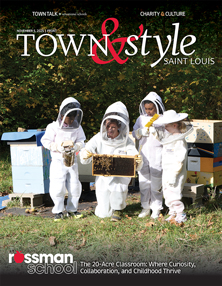
Located on 20 acres in St. Louis County, Rossman School serves children in junior kindergarten through grade six. The independent elementary school offers a challenging curriculum in academics, arts and character growth. Pictured on the cover: Rossman students enjoy beekeeping as part of their outdoor education. For more information, call 314.434.5877 or visit rossmanschool.org.
Cover design by Julie Streiler
Cover photo by Tim Parker Photography
Pictured at the top: Rossman students helped harvest 40 pounds of honey from the school’s beehives this year.
Photo courtesy of Rossman School