On 90 emerald acres in St. Charles County, wonderful things are happening: Nonverbal children are learning to speak, individuals with physical disabilities are becoming strong, and people with emotional issues are starting to trust. TREE House of Greater St. Louis, founded in 1975 as Therapeutic Horsemanship, is one of the oldest and most respected therapeutic riding centers in the United States. With a team of occupational, physical and speech therapists, volunteers and 25 horses, it serves clients age 2 through adulthood who have physical, mental, emotional, social and learning difficulties. “We’ve been in business for 40 years, and we’ve seen success in 98 percent of our clients,” says Sandy Rafferty, occupational therapist and founder.
The TREE House treatment program, known as Equine-Assisted Therapy (or hippotherapy), uses a horse’s movement to treat people with physical challenges. “A horse’s typical walking gait exactly replicates a human’s: around, side-to-side, up-and-down,” Rafferty explains. This means that over time, a human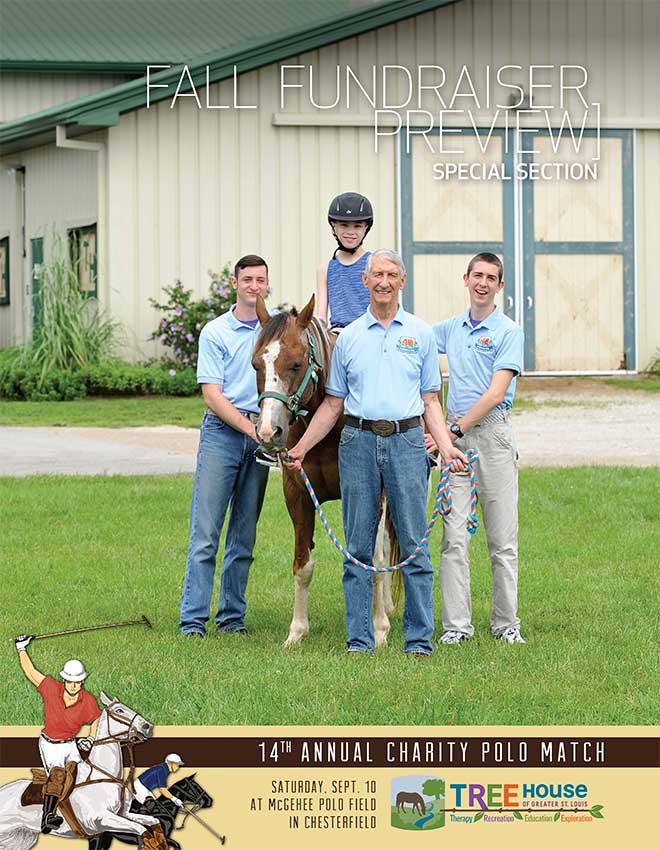 body can learn to mimic correct movement, find balance and achieve flexibility and strength. All TREE House therapists are experts in equine-assisted therapy, suitable for disabilities like cerebral palsy, Down syndrome, muscular dystrophy and multiple sclerosis.
TREE stands for ‘Therapy,’ ‘Recreation,’ ‘Education’ and ‘Exploration.’ Among the services TREE House delivers is an Adaptive Therapeutic Riding Program that advances client-specific horsemanship skills and an Equine-Assisted Mental Health Program that uses interaction with horses to address emotional issues like depression, anxiety and stress. “If a person has poor selfesteem or detachment issues, the bond they develop with the horse is a huge source of joy and pride,” Rafferty explains, adding that she has heard nonverbal children speak their first words to a TREE House horse. The nonprofit’s equines undergo an intensive 30-day evaluation process and are selected for their gentle and cooperative natures, she says. All therapists are licensed within their professions, and all riding instructors are certified by the Professional Association of Therapeutic Horsemanship International.
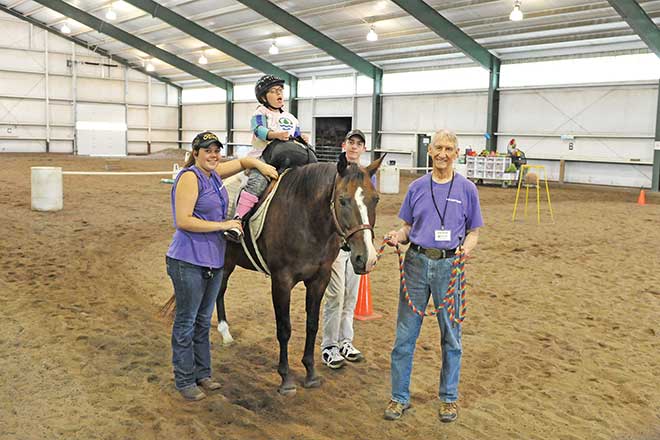
Those qualities have made a world of difference to Lilly Opinsky, who has been riding at TREE House for 13 years. Lilly uses a wheelchair, is nonverbal and requires full-time assistance, but her father, Larry Opinsky, says seeing her on her horse is spectacular. “She controls her body and is proud and free.” Opinsky also applauds the emotional bond Lilly has formed with her horse. “The horse can sense my daughter, he understands her. They have a deep connection.” He adds that no other treatment he has sought for Lilly has come close to being as effective. “It’s remarkable.”
On Sep. 10, the nonprofit hosts its 14th Annual Charity Polo Match at McGehee Polo Field in Chesterfield. “What we do would not be possible without our many volunteers and donors,” says Nathan Harms, director of operations. “We are excited for our event and grateful for all the support.”
Pictured: Lilly Opinsky receives treatment.
Photo: Bill Barrett
TREE House of Greater St. Louis (formerly Therapeutic Horsemanship) is one of the oldest and most respected, PATH International Premier-Accredited Centers in the world. On Sep. 10, it hosts its 14th Annual Charity Polo Match at McGehee Polo Field at Spirit Valley Farms in Chesterfield. Pictured on the cover: The TREE House team of volunteers, therapy horses, therapists and riding instructors works with two children. For information, call 636.332.4940, or visit thstl.org.
Cover design by Allie Bronsky | Cover photo by Bill Barrett