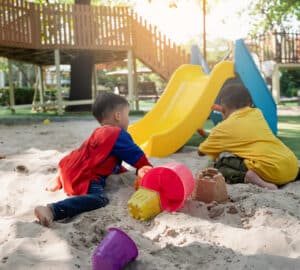


It worries me that children are hearing and watching adults around them choose conflict over cooperation. That is not how I want our children to learn about dealing with friendships, dating relationships or other countries. Charles Darwin’s research on mankind’s nature and evolution mentions survival of the fittest only twice, but love is brought up 92 times. He believed that man’s essential nature was cooperation, not competition. Let me offer some different examples of how animals and people can learn to cooperate and live in harmony.
Colorado aspens are found in clusters, or groves. This is because they can multiply from their roots, sending up lots of new shoots every year. These become saplings that grow quickly. In some groves, all of the trees may actually be connected by their roots. It is as if they are one tree.
Another tree, the giant California redwood, may tower 300 feet into the sky, but its roots are actually shallow—they spread out wide in search of surface water. And they reach in all directions, intertwining with roots of other redwoods. Locked together in this way, all the trees support each other in wind and storms.
When faced with an oncoming storm, cows tend to run away from it. They attempt to escape, but this often prolongs their exposure to the elements and their suffering. Buffaloes have a different approach. Instead of trying to evade the storm, they charge directly into it. They face the challenge head-on, navigating through it with determination and efficiency. Buffaloes often travel in herds, supporting each other through tough conditions. Their collective strength and shared determination help them face challenges like storms more effectively.
Finally, a human example of the power of cooperation: An anthropologist proposed a game to a group of young children who belonged to a remote African tribe. He placed a basket of fruit under a tree and told the children that whoever got to it first could have all the fruit inside. To his surprise, the children joined hands and ran to the tree together. When they reached the basket, they all sat down to enjoy the fruit as a group. The scientist asked why the children had run together instead of racing to get all the fruit. One child spoke up. “Ubuntu.” “What does ‘ubuntu’ mean?” the anthropologist asked. One child responded, “How can one of us be happy if all the others are sad?”
According to Archbishop Desmond Tutu, it’s a common concept in Bantu languages: “Ubuntu is the essence of being a person. It means that we are people through other people. We cannot be fully human alone. We are made for interdependence; we are made for family. When you have ubuntu, you embrace others. You are generous and compassionate.”
I’d like for our children to hear these types of stories from nature and from peaceful communities instead of the hatred and hunger for power so often shown in today’s news stories. There is a better way to live.
Tim Jordan, M.D., is a Behavioral Pediatrician who counsels girls aged grade school thru college. Listen to his weekly podcast, Raising Daughters, to gain information on raising strong, resilient girls. For more info on Dr. Jordan’s retreats, summer camps and books visit drtimjordan.com.